

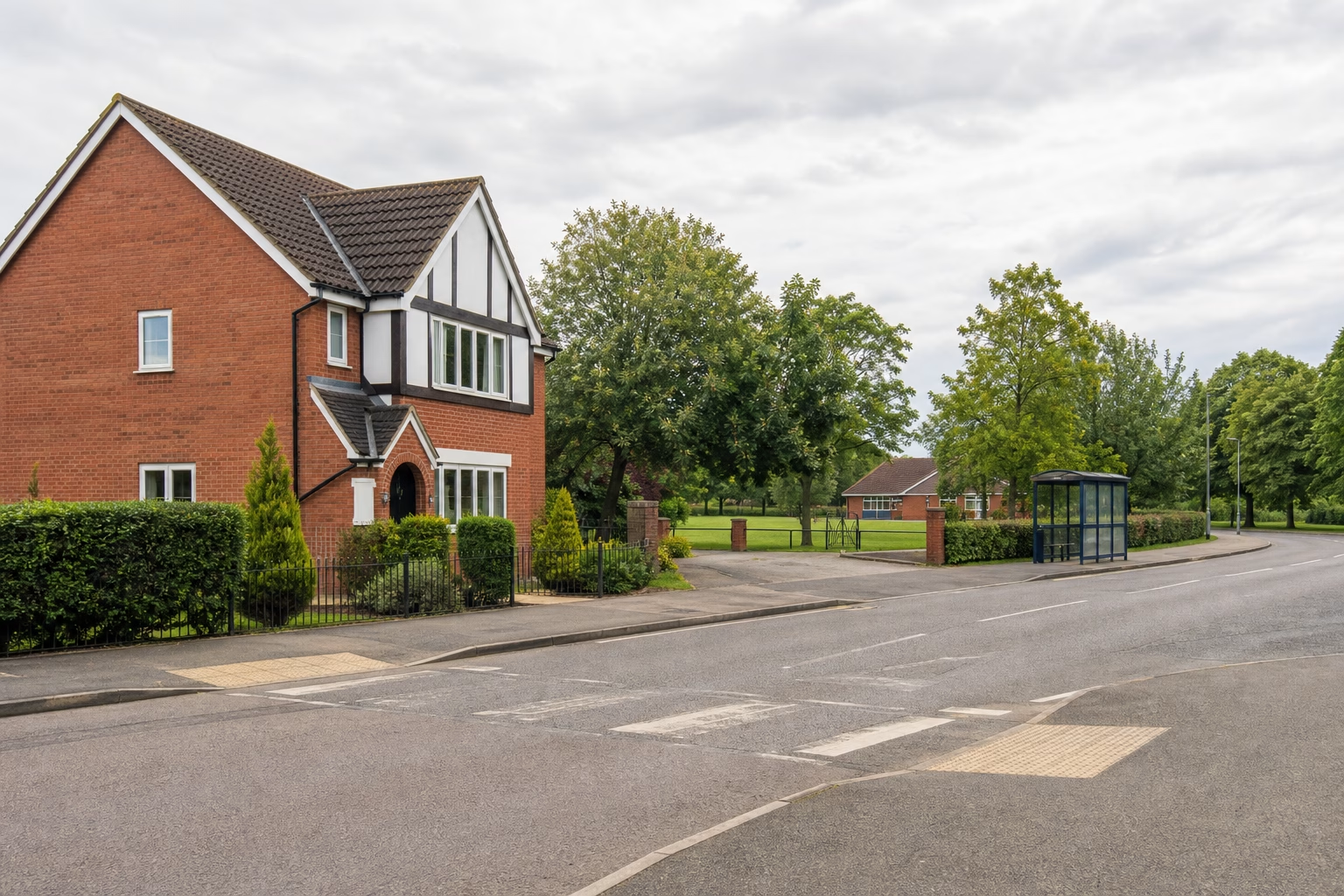
The location of a children’s home shapes children’s daily lives. It affects access to education, health care, family time, public transport, positive activities and supportive communities. It can also expose children to exploitation, unsafe roads, environmental hazards or areas connected with previous harm.
Regulation 46 of the Children’s Homes (England) Regulations 2015 requires the registered person to review the appropriateness and suitability of the home’s location at least once in each calendar year. The review must take account of the protection of children standard and include consultation with relevant people.
This guide explains how the annual review differs from a one-off registration document, what evidence to examine and how to turn findings into practical action.
Images in this guide are AI-generated illustrations, not photographs of Welcare premises or evidence of a particular home’s facilities.
Key point:
A location is not simply safe or unsafe. The review should assess how the setting interacts with the needs of current and likely children, identify both protective and risk factors, and show how the provider manages what it finds.
What Regulation 46 requires
Regulation 46 requires the registered person to
Regulation 12(2)(c) requires the registered person to ensure that the home’s location is so far as reasonably practicable free from avoidable risks that may result in harm to a child.
The wording recognises that no community is risk-free. The provider must identify avoidable risks, choose proportionate controls and keep the overall suitability of the location under review.
Annual review, location assessment and planning approval
Three processes are sometimes confused.
Registration location assessment
Ofsted’s current children’s home registration guidance requires applicants to provide a location assessment. It helps Ofsted understand why the proposed setting is suitable and how identified risks will be managed.
Regulation 46 annual review
Once the home operates, Regulation 46 requires a review at least once in each calendar year. It should consider current evidence, consultation and the children using the service. It is not satisfied by retaining the original registration assessment unchanged.
Planning use
Planning permission and the use class of the premises are matters for the local planning authority. Planning approval does not prove that a location is suitable for the children, and a Regulation 46 review does not determine planning law.
Welcare’s guide to C2 planning use for children’s homes covers that separate question
At least once in each calendar year
The regulation uses calendar years, not a rolling phrase such as “every 12 months”. The provider should make sure one review is completed in each January to December period.
A review only once a year may be insufficient where circumstances change. Ofsted’s current social care common inspection framework expects the assessment to be updated annually and whenever necessary.
An early review may be needed after:
A serious incident or cluster of missing episodes
New exploitation intelligence
A significant crime or antisocial behaviour pattern
A change in the children accommodated
Expansion into another building
Loss of a school, health service or transport route
A major neighbouring development
Community conflict or targeting of the home
Flood, fire or other environmental change
Evidence that existing controls are ineffective
The policy should identify who decides whether a trigger requires a full review or targeted update.
Define the premises and area considered
The review should identify every building and outdoor area used for the purposes of the home. If the registration includes more than one building, the provider should assess the suitability and risks of each, not rely on one generic description.
The geographical scope should follow children’s real lives. A narrow circle around the front door may miss the bus stop, school route, nearby park, shopping area, railway station or places where children spend time.
The review can consider several layers:
The premises and immediate boundary
Neighbouring properties and streets
Common walking and transport routes
Local services and activities
Places linked to missing or exploitation risk
wider travel needed for education, health and family contact
The purpose is not to produce a decorative map. It is to understand exposure, access and protective factors.
Start with the home's purpose and children
A location that is appropriate for one home may be unsuitable for another. The review should refer to the statement of purpose and consider the needs of current children without publishing unnecessary personal details.
Relevant factors may include:
- Age and developmental stage
- Disability and mobility
- Communication needs
- Education placement
- Health and therapeutic support
- Family and community connections
- Previous exploitation or trafficking
- Missing-from-care patterns
- Gang or peer associations
- Online contacts linked to physical locations
- Sensory needs
- Independent travel skills
- Identity, culture, religion and access to community
The review should also consider the broad profile of children the home intends to accommodate. It cannot predict every future placement, so each referral still needs individual matching under Regulation 17 placement planning.
Crime, exploitation and missing risk
Local crime data can inform the review, but headline statistics do not decide suitability. The provider needs relevant, current context.
Useful evidence may include:
- Police and community safety information
- Local safeguarding partnership priorities
- Child criminal and sexual exploitation profiles
- Trafficking or county lines intelligence
- Patterns around transport hubs, hotels, parks or licensed premises
- Known gang boundaries or peer networks
- Missing-from-care locations
- Online-to-offline meeting risks
- Changes reported by local practitioners
Sensitive intelligence may not be available in a public dataset. Consultation with police, local authority services and placing professionals can add context.
The review should describe how the risk affects children and what control is possible. Simply writing "high crime area" is neither analytical nor fair to the community.
Roads, transport and physical hazards
The setting should support safe movement, Consider:
- Traffic speed and crossing points
- Railway lines and stations
- Rivers, canals, coast or open water
- Derelict buildings
- Isolated paths
- Industrial sites
- Pollution and noise
- Flood risk
- Lighting
- Pavement and wheelchair access
- Public transport availability
- Taxi reliability
- Winter conditions
- Emergency-service access
A hazard may be manageable through building work, travel support, staffing or route planning. Other hazards may fundamentally undermine suitability for the intended group.
Regulation 25 fire precautions guide covers fire duties within the home. The location review can add external factors such as wildfire exposure, access for fire appliances or neighbouring industrial risk.
Education, health and therapeutic services
A children’s home should not be considered in isolation from the services children need. The review should examine realistic access, capacity and travel time for:
- Schools, colleges and alternative provision
- General practice and dentistry
- Pharmacies
- Child and adolescent mental health services
- Hospitals and urgent care
- Specialist disability services
- Substance misuse support
- Sexual health services
- Advocacy
- Youth services
- Therapeutic provision
A service appearing on a map does not mean a child can access it. The provider should consider referral criteria, waiting times, transport and whether placements from other local authorities face barriers.
Long journeys can affect education attendance, family contact and emotional wellbeing even where the route is technically possible.
Family time, identity and positive community links
Suitability also includes opportunity. The review should identify resources that help children build ordinary, connected lives.
Positive factors may include:
Libraries
Sports clubs
Parks and leisure centres
Arts and music provision
Faith and cultural communities
Shops and practical services
Volunteering and work experience
Youth groups
Safe public transport
Welcoming neighbours
The location should support identity and relationships. A child may need access to a particular cultural community, place of worship, language group or family network.
Positive factors should be specific. A list of amenities is less useful than an explanation of whether children can and do use them.
The home, neighbours and community
The provider should consider the relationship between the home and its surroundings while protecting children’s privacy. Concerns might include harassment, complaints, hostile attention, overlooking, noise, unsafe visitors or adults targeting the address.
Good community engagement can improve safety and belonging, but the home should not disclose that individual children are looked after or share confidential information.
The review can address:
Children’s needs and rights must remain central. Community pressure should not create punitive restrictions.
Staffing and operational impact

Location affects workforce stability and emergency response. The provider should consider:
- recruitment catchment;
- public transport for shifts;
- travel during nights or severe weather;
- access for agency or on-call staff;
- management response time;
- emergency-service access;
- staff parking and personal safety;
- travel demands created by school and appointments; and
- whether deployment remains safe when staff leave the building with children.
A remote setting may offer calm and space but create transport and staffing challenges. An urban setting may offer services but expose children to busy environments or known networks. The review should examine the actual balance.
This connects with Regulation 31 staffing and continuity.
Consultation with relevant people
Regulation 46 requires consultation and consideration of each relevant person’s views. The provider should identify who can contribute meaningful knowledge.
Depending on the home, consultation may include:
- Children living in the home
- Placing authorities
- Parents where appropriate
- Independent reviewing officers
- Local authority children's services
- Police and community safety teams
- Health and education partners
- The local safeguarding partnership
- The independent person
- Staff and managers
- Neighbours or community organisations where appropriate
- Specialists in exploitation, traffic, fire or environmental risk
The review should record who was consulted, the question asked, the response and how it influenced the conclusion. A list of emails sent is not the same as taking views into account.
Where no response is received, the provider should record reasonable follow-up and use other evidence.
Hearing children's views safely
Children often understand the local area differently from adults. They may know which routes feel unsafe, where bullying occurs, which transport is unreliable and which places help them feel part of the community.
Consultation can use mapping, walks, house meetings, individual key work or accessible surveys. Children should not be asked to disclose sensitive risk information in a group.
The final review should show how children’s views affected action. It should also explain where a requested change cannot be made and what alternative is offered.
Evidence sources
A credible review draws on several sources rather than one crime map. These may include:
- The previous review and action plan
- Missing and incident analysis
- Safeguarding referrals
- Children's and staff feedback
- Police or local authority intelligence
- Local safeguarding publications
- Transport and service information
- Environmental and flood data
- Site walks at different times;
- Complaints or neighbour contacts
- Education and health access
- Regulation 44 reports
- Regulation 45 quality-of-care review
- Inspection findings
Sources should be dated. Older information may still matter, but the review should explain why it remains relevant.
From risk identification to controls
For each significant issue, the review should show:
Controls may include enhanced staffing for a route, transport arrangements, environmental improvements, liaison with police, individual safety planning, staff training, service agreements or a limit on accepting a placement that cannot be supported safely.
The provider should distinguish controls it owns from actions dependent on another agency. Dependencies need follow-up, not assumption.
Worked Example: A Bus Route Is Withdrawn
Listing a nearby school or clinic on a map does not establish that children can reach it. If a bus route is withdrawn, an illustrative review entry could record:
Impact
Which education, health or family-time arrangements may be disrupted, including the child's view of the proposed alternative
Unresolved risk
Any journey without a reliable alternative, escalated for a decision rather than described as resolved
Control
A confirmed transport arrangement, with a named person responsible for checking availability, cost and staffing implications
Evidence
The dated service change and the journeys previously relying on it
Review trigger
A missed journey, a change in the child's needs or a further service change
The example is not a claim about Welcare’s locations. It shows why availability, accessibility and dependable arrangements matter more than distance alone.
Reaching and recording the conclusion
The review should make a clear conclusion about whether the location and premises remain appropriate and suitable for the home’s purpose.
A conclusion might be:
- suitable with existing controls;
- suitable subject to specified improvements;
- temporarily unsuitable for a particular placement profile;
- requiring urgent provider action; or
- no longer suitable for the service.
The decision should reflect the evidence and consultation. Where significant risks remain, the provider should decide whether to restrict admissions, increase resources, alter the service or consider relocation.
A long document with no conclusion or action is not an effective review.
Multi-building homes
Where a home operates across more than one building, each building’s immediate environment, travel routes, boundaries and local relationships should be considered. Shared factors can be analysed once, but building-specific risks and controls must remain visible.
The review should also assess movement between buildings, staff deployment, emergency access and whether children in each building can reach the same services and support.
Ofsted’s current framework notes that the location assessment should show how the suitability of each building has been considered.
Keeping sensitive information safe
The review may contain exploitation intelligence, known locations, security weaknesses or details that could identify children. It should be stored and shared carefully.
A version supplied for wider consultation may need redaction or separation of sensitive annexes. Data protection should not be used as a reason to omit necessary analysis, but access should follow role and need.
Regulation 38 requires the annual review to be kept in an accessible manner. Accessible means available to authorised people, not public.
What Ofsted may examine
Inspectors may compare the review with children’s experiences, incident patterns, staff knowledge and the provider’s actions. They may ask whether risks changed and whether the document was updated.
Evidence may include:
- the current and previous review;
- consultation responses;
- action tracking;
- placement decisions;
- missing and safeguarding analysis;
- local intelligence;
- children’s views;
- multi-building analysis;
- Regulation 44 and 45 reports; and
- changes made after incidents.
A generic assessment that could describe any town is unlikely to demonstrate meaningful oversight.
Common weaknesses
Common weaknesses include updating only the date, relying solely on public crime statistics, treating planning permission as evidence of suitability and ignoring positive community factors.
Other problems include no child consultation, no building-specific analysis, old service information, risks without owners, actions without completion evidence and highly sensitive detail circulated too widely.
Regulation 46 audit checklist
- A review is completed at least once in each calendar year.
- Earlier update triggers are defined and used
- Every premises and building is covered
- The geographical scope reflects children's actual routes
- Current and likely children's needs inform the analysis
- Crime and exploitation evidence has local context
- Roads, transport and environmental hazards are assessed
- Education, health and therapeutic access is realistic
- Positive community and identity resources are considered
- Staffing and emergency response implications are included
- Relevant people, including children, are consulted
- Views are considered, not merely collected
- Significant risks have controls, owners and deadlines
- The review reaches a clear suitability conclusion
- Sensitive information has controlled access
- Findings inform referrals and placement matching
Frequently Asked Questions (FAQs)
At least once in each calendar year. It should also be updated when significant changes make the existing assessment unreliable.
No. It may be one source, but the review should combine current local intelligence, children's experiences, service access, physical hazards, incident patterns and consultation.
No area is risk-free. The legal focus is on avoidable risks so far as reasonably practicable and the overall appropriateness and suitability of the location.
Regulation 46 requires consultation with each relevant person. Children's views are central to understanding how the area feels and works in daily life and should normally form part of the evidence.
No. Planning status and children's home suitability are separate questions. The provider must complete the child-centred annual review even where planning use is established.
