

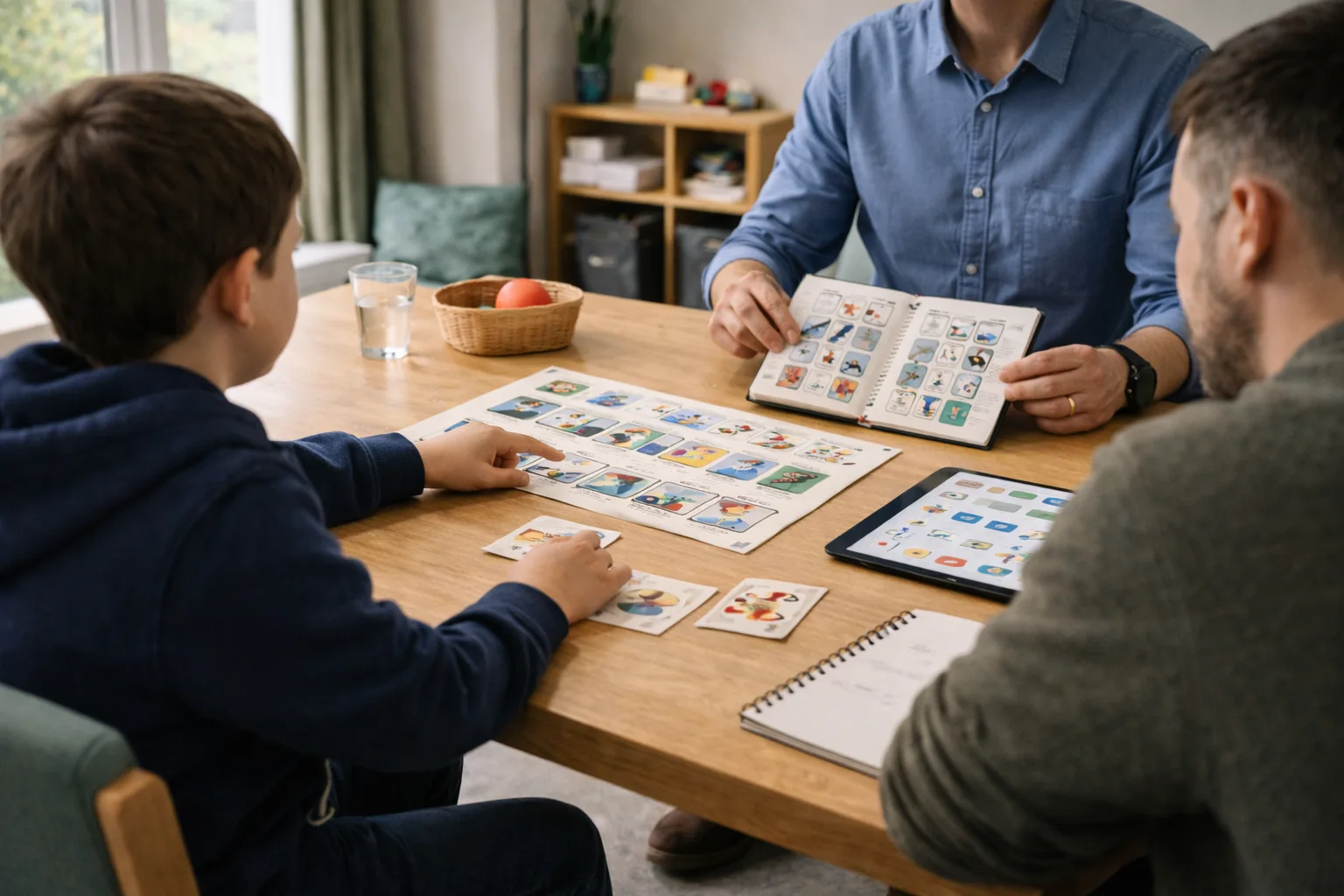
What “nonverbal” can mean
Families use the term “nonverbal” in different ways. It might mean your child:
- does not use spoken words yet
- uses a few words but not reliably
- uses words only in certain situations
- understands more than they can say
- communicates mainly through behaviour, gestures, or sounds
A helpful starting point is recognising this: your child is communicating all the time. Our job is to notice the signals, reduce stress, and give them reliable ways to express needs and choices.
The National Autistic Society explains that autistic people can communicate in different ways and may find aspects of communication more challenging.
The goal: connection, not perfect speech
When you are looking for communication strategies for nonverbal children with autism, it is easy to feel pressure to “get them talking”.
Speech can develop for some children over time, but the bigger goal is:
shared understanding
less frustration
more independence
more participation at home and school
AAC is not “giving up on speech”. It is a bridge that helps children communicate now. Research and clinical guidance commonly describe AAC as a way to support functional communication for minimally verbal children. (Oxford Health NHS Foundation Trust)
Start here: build a communication profile
Before you change anything, spend a week noticing patterns. This gives you clarity and helps speech and language professionals too.
What to track
What triggers shutdown or distress
noise, demands, waiting, transitions
How they say no
pushing away, dropping, crying, running off
How they show discomfort
covering ears, pacing, biting sleeves, hiding
What helps them engage
music, water play, movement, quiet corners
How your child asks for things
pulling your hand, pointing, vocalising, leading you
This becomes your child’s communication dictionary. It is the foundation for the strategies below.
Everyday strategies that help at home
A) Follow their lead first
Connection often starts when you join your child’s interest without taking over. This is how you build shared attention, which supports communication.
Try:
sit near and copy what they do for a moment
pause and wait for a response
mirror their rhythm and pace
B) Use fewer words and more clarity
In stress, language can feel like noise. Use:
One short phrase
A pause
A visual cue
Example :
“Shoes on.” then point to shoes
“Snack.” then show snack picture
C) Give more processing time
Ask, then wait. Many children need longer to process language and respond.
D) Offer choices in a visual way
Choices reduce frustration and behaviour escalations.
Use two options:
show two items
show two pictures
show two symbols on a board
E) Narrate, do not quiz
Instead of lots of questions, try calm narration:
“You want the bubbles."
“You’re telling me it is too loud.”
“You chose the blue cup.”
This reduces pressure and teaches vocabulary without forcing speech.
AAC explained simply: options that work
AAC means Augmentative and Alternative Communication. It includes low tech and high tech tools that support communication.
Common AAC types
- Objects and photos: real items or photos that represent choices
- Symbols and picture cards: for requests, routines, feelings
- Communication boards or books: pages of symbols your child can point to
- Signing systems: like Makaton
- Speech generating devices or apps: for children who benefit from technology
Oxford Health NHS explains AAC can include objects, symbols, photos, signing and electronic aids, and that needs can change over time.
The National Autistic Society provides an overview of AAC and includes PECS as one approach.
PECS, signing, and visual supports: practical setup
A) PECS basics
PECS is a structured system where a child exchanges a picture to communicate, often starting with requesting. The National Autistic Society describes PECS as typically used to teach autistic children with speech and language delay how to initiate communication. (National Autistic Society)
Some NHS resources also mention PECS as a visual support for expressive communication.
Simple home setup
- Start with 3 to 5 highly motivating items (snack, bubbles, favourite toy)
- Use clear photos or symbols
- Keep cards in one accessible place
- Teach one request first: “I want bubbles”
Key tip: keep it consistent. PECS works best when everyone uses the same approach.
B) Makaton and signing
Signing can reduce frustration, especially for quick needs like “more”, “help”, “stop”, “toilet”, “finished”. Makaton describes itself as combining signs, symbols and speech to support communication and understanding, including for autistic people.
How to start
- Pick 5 core signs only
- Use the sign and the spoken word together
- Celebrate any attempt to communicate, even imperfectly
C) Visual routines
Visual routines reduce anxiety and make communication easier.
Start with one routine:
- morning steps
- after school steps
- bedtime steps
Use photos, symbols, or drawings. Keep it short.
Reducing frustration and challenging moments
Many “behaviour” moments are communication breakdown moments.
Spot the common triggers
Waiting
Transitions
Sensory overload
Unclear expectations
demands without a way to say “no” or “help”
Teach three powerful messages first
Before anything else, help your child communicate:
Help
Break
Finished
These reduce distress because they give your child a safe way out.
Use a calm repair after the moment
When your child is calm:
Name what happened simply
Practise once, then move on
Model the message they could use next time
Example:
- “That was too loud.”
- show “break” card
- practise going to the calm corner
Working with nursery and school

Consistency matters. Home and school do not need identical tools, but they should align.
What to ask nursery or school for:
- a shared set of core symbols or signs
- a visual timetable
- a way for your child to request help and breaks
- staff consistency during transitions
- a calm space for regulation
Bring your communication profile and share:
- what your child uses at home
- what triggers distress
- what helps them recover
Getting help in the UK: school, OT, and support routes
Speech and language support
NICE guidance for autistic children and young people advises consulting a speech and language expert in the autism team when managing receptive and expressive language needs, including when children are nonverbal.
Routes vary by area, but common starting points include:
GP
Health visitor (under 5s)
Nursery or school SENCO
Local children’s therapy services
Specialist AAC services
For complex AAC needs, NHS England’s commissioning guidance explains that specialised AAC services provide assessment and equipment for those with the most complex communication needs, including high tech communication aids.
Great Ormond Street Hospital describes its Augmentative Communication Service and notes it is part of a small number of NHS England identified specialist services.
FAQs
Many families use it. Some prefer “minimally verbal” because communication can vary. The most important thing is respecting your child and focusing on practical support.
AAC is widely used to support communication. It can reduce frustration and support language development for many children. (Oxford Health NHS Foundation Trust)
Start with messages that reduce distress:
help
break
finished
Then add requests and choices.
That usually means the system is too hard, not motivating, or introduced in a stressful moment. Go back to:
one favourite item
one card
one success
Then build slowly.
If communication difficulties are causing frequent distress, impacting learning, or leaving your child without a reliable way to express needs, speak to your GP, nursery or school and ask about speech and language therapy. NICE supports speech and language expert input for these needs. (NICE)