

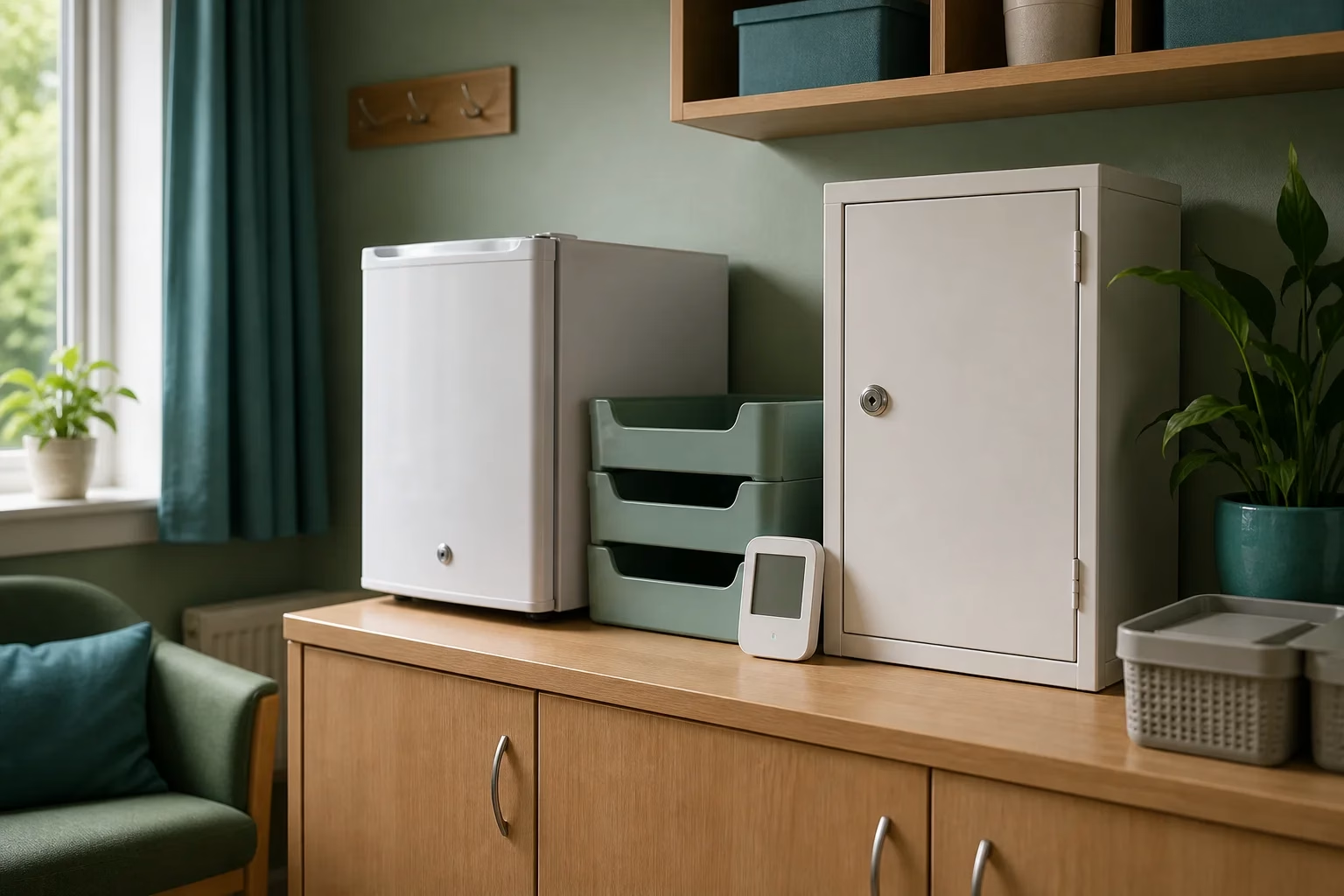
Images in this guide are AI-generated illustrations, not photographs of Welcare premises or evidence of a particular home’s facilities.
The medicine images do not demonstrate a complete or approved storage or administration system.
What does Regulation 23 require?
Regulation 23 of the Children’s Homes (England) Regulations 2015 requires the registered person to make arrangements for:
The registered person must also ensure that medicines are securely stored to prevent unsupervised access by children, prescribed medicines are administered as prescribed and only to the child named in the prescription, and administration is recorded.
There is an important exception for self-administration. A child may keep and take their own medicine when it can be stored so that other people cannot use it and the child can do so safely.
Why medicines management is more than a locked cupboard
Safe storage is only one part of the system. Errors can arise when information is incomplete, a prescription changes, staff misunderstand an instruction or a child moves between settings.
A strong medicines process covers the full journey:
1. obtaining current information
2. receiving and checking medicines
4. administering or supporting self-administration
3. storing them under the correct conditions
5. recording what happened
6. monitoring effects and concerns
8. transferring information when the child moves
7. reviewing treatment with health professionals
9. disposing of unwanted or expired medicines safely
The home’s medicines policy should define responsibility at each stage and explain how staff respond outside normal office hours.
Why medicines management is more than a locked cupboard
Safe storage is only one part of the system. Errors can arise when information is incomplete, a prescription changes, staff misunderstand an instruction or a child moves between settings.
A strong medicines process covers the full journey:
1. obtaining current information
2. receiving and checking medicines
3. storing them under the correct conditions
4. administering or supporting self-administration
5. recording what happened
6. monitoring effects and concerns
7. reviewing treatment with health professionals
8. transferring information when the child moves
9. disposing of unwanted or expired medicines safely
The home’s medicines policy should define responsibility at each stage and explain how staff respond outside normal office hours.
Before a child arrives
Medication information should form part of referral and placement planning.
The home should establish:
- the current medicine name, strength, dose, route and timing
- why each medicine is prescribed
- allergies and previous adverse reactions
- the prescriber and usual GP
- the supplying pharmacy
- whether monitoring, blood tests or physical observations are required
- instructions for medicines prescribed when required
- arrangements for controlled drugs or medicines needing refrigeration
- the child’s understanding, preferences and previous level of independence
- who can consent to treatment and how decisions are recorded
- enough supply to avoid an unintended gap
- the latest medicines administration record or equivalent transfer information
If information conflicts, staff should check with an appropriate health professional before administering. Guessing from an old label, verbal recollection or previous routine is unsafe.
Welcare’s Regulation 17 placement-plan guideexplains how health arrangements should connect with the wider placement plan.
Medicines reconciliation
Medicines reconciliation means creating an accurate current list and resolving discrepancies when care transfers.
It is especially important when a child:
Enters the home
Returns from hospital
Changes GP or pharmacy
Comes back from family time with medicines
Receives a new prescription
Moves to another placement
The process should compare the prescription, pharmacy label, discharge information, administration record and what has physically arrived. Unexplained differences should be referred to the prescriber, pharmacist or another appropriate clinician.
The final record should identify who completed the check and when.
Storage and access

Regulation 23 requires secure storage that prevents unsupervised access by children, except where a child safely keeps medicine for self-administration.
Storage arrangements should reflect the medicine and individual risk.
The home should consider:
locked storage accessible only to authorised staff
separate storage where needed to avoid selection errors
refrigerator temperatures for medicines requiring cold storage
secure and well-governed arrangements for controlled drugs
safe storage of creams, inhalers, nutritional products and medical devices
access during outings, education and family visits
keys, codes and emergency access
stock rotation and expiry dates
safe disposal through agreed pharmacy or clinical routes
Medicines should remain identifiable. Transferring tablets into unlabelled containers or leaving doses prepared without control can create serious risk.
Safe administration
NICE recommends a structured administration process.
A familiar check is the six rights:
Right child
Right medicine
Right route
Right dose
Right time
The child’s right to refuse
Staff should also check the prescription status, expiry, allergies, relevant observations and whether the dose has already been given.
The record should be completed promptly after administration. Recording before giving a medicine can create a false entry if the child refuses, is unavailable or the dose is dropped.
Staff should never give one child medicine prescribed for another, even when the product and dose appear identical
Medicines prescribed when required
A medicine prescribed when required needs an individual protocol.
It should state:
- the reason it may be offered
- signs or symptoms staff should look for
- the dose and route
- the minimum interval between doses
- the maximum amount in a stated period
- non-medicine strategies to try where appropriate
- what effect is expected and when
- when to seek clinical advice
- what to record
- how repeated use will be reviewed
The phrase “when needed” is not enough. Staff need objective guidance that supports consistent and child-centred decisions.
Repeated use may indicate an unmet health need, ineffective care plan or need for clinical review. It should not simply become part of the routine.
Refusal and missed doses
The DfE guide says records should include occasions when prescribed medicine is refused. A child’s refusal should be approached calmly and without punishment.
Staff should:
- listen to the reason where the child wishes to explain
- seek clinical advice about refusal and any necessary specialist legal assessment; a staff decision or care plan alone does not authorise disguised or forced medicine
- check the prescription or protocol for missed-dose advice
- seek prompt advice where omission may create risk
- record the offer, refusal, explanation and action
- inform the relevant health professional and social worker as required
- review recurring refusal with the child and clinical team
A refusal record should not blame the child. It should help the team understand barriers such as side effects, swallowing difficulty, stigma, timing, sensory needs or lack of explanation.
Self-administration
Supporting independence can be beneficial, but it needs an individual assessment.
Relevant factors include:
the child’s understanding of the medicine and dose
ability to recognise and report side effects
risk of accidental or intentional overdose
risk that another child could gain access
storage arrangements
reminders or prompts needed
the child’s wishes
the views of the prescriber
how staff will monitor supply and outcomes
when the arrangement will be reviewed
Self-administration is not all or nothing. A child might safely keep an inhaler while staff manage another medicine, or progress from supervised preparation to greater independence.
The assessment and decision should be recorded in the child’s plan.
Non-prescription products and homely remedies
A home should have clear arrangements for non-prescription medicines and common remedies.
The process should cover:
Staff should not offer a product simply because it is available without prescription. Herbal products, supplements and common pain relief can interact with prescribed treatment or be unsuitable for a child’s condition.
Consent and covert administration
Covert administration means giving medicine without the child’s knowledge. Staff must not decide to hide or force a medicine because it has been refused. A prescription, placement agreement or care plan is not, by itself, authority to override consent or refusal.
Consent is age- and decision-specific. Young people aged 16 or 17 are generally presumed able to consent to treatment; a child under 16 may also be able to consent if sufficiently competent to understand it. Where a child cannot consent, parental responsibility and other legal powers may be relevant, but their limits must be assessed. See the NHS guidance on children and consent to treatment.
Any proposed treatment without the child’s knowledge requires an individual clinical assessment and confirmation of the lawful basis, with specialist legal advice where needed. Do not apply an adult care-home capacity or best-interests process indiscriminately to children. The appropriate clinician should lead decisions about treatment and refusal, involving the child and those legally responsible for them. Urgent health risks require immediate medical help.
Only after a lawful decision has been established should the prescriber and pharmacist advise on safe administration and formulation. Staff must not independently alter a medicine or mix it with food. The decision, safeguards and review arrangements should be documented.
Medication errors and near misses
A medicines error may include:
- wrong child, medicine, dose, route or time
- omitted or duplicated dose
- medicine administered after it was stopped
- incorrect storage
- missing stock
- inaccurate record
- failure to act on a refusal or adverse effect
The first priority is the child’s health. Staff should seek clinical advice immediately through the agreed route, follow emergency instructions and be honest about what occurred.
The home should then:
- notify the manager
- preserve accurate records
- inform the child and relevant people appropriately
- complete safeguarding or regulatory notifications where thresholds are met
- investigate causes rather than focusing only on individual blame
- update risk controls
- share learning with staff
- monitor whether changes work
Near misses are also valuable. They show where a system nearly failed and allow improvement before harm occurs.
Training and competency
Completion of a medicines course does not by itself prove competency.
Staff need to demonstrate that they can safely:
- read prescriptions and labels
- use administration records
- measure and administer relevant formulations
- follow when-required protocols
- respond to refusal
- store and dispose of medicines
- identify errors and adverse effects
- seek appropriate clinical advice
- respect consent, privacy and independence
Competency should be assessed in practice, recorded and revisited after an error, a long absence, a new medicine system or a change in responsibilities.Agency staff need an appropriate local induction before undertaking medicine duties.
Auditing the system
Managers should audit both records and practice.
Useful checks include:
- stock matches administration records
- signatures and codes are complete and understood
- refusals and omissions have clear follow-up
- when-required use matches the individual protocol
- refrigerator and storage checks are current
- controlled drug processes are robust
- expired or discontinued medicines are removed
- self-administration assessments remain current
- medicine changes are reflected across all plans
- errors and near misses lead to learning
Patterns matter. Repeated late doses, missing signatures or frequent when-required use may reveal staffing, training, communication or clinical problems.
What will Ofsted look for?
Ofsted’s SCCIF considers whether children’s health needs are identified and addressed, whether medication arrangements are safe and effective and whether independence is promoted where possible.
Inspectors may speak with children, observe storage, sample administration records and compare them with health and placement plans.
They may explore:
- how a medicine change reached the staff team
- what happens when a child refuses
- whether staff are competent
- how errors are managed
- whether the child understands their treatment
- how the home works with GPs, pharmacists and specialist services
The aim is not a perfect filing system. It is safe, personalised health support that improves the child’s experience.
Frequently Asked Questions (FAQs)
Yes, when it can be stored so other people cannot use it and the child can safely self-administer. The decision should follow an individual assessment and be kept under review.
Yes. The DfE guide states that administration records include occasions when prescribed medicine is refused. The record should also show the action taken.
Only within the home’s agreed process, with relevant clinical, consent and delegated-authority considerations addressed. Staff should check allergies, interactions, age limits and maximum doses.
Protect the child first and obtain clinical advice immediately. Then follow reporting, notification, investigation and learning procedures. Staff should not conceal or retrospectively alter records.
Yes. The registered person must make suitable arrangements for disposal as well as handling, recording, safekeeping and administration.
NICE SC1 is good-practice guidance and does not replace the legal requirements or individual clinical judgement. The DfE guide specifically signposts it for children’s homes.

This guide describes England’s regulatory framework and general good practice. Medicine decisions must follow current prescriptions, clinical advice, local procedures and the child’s individual plan.